Before you start
On 22 August 2026, Kijai added trellis_2_int8_convrot.safetensors to Comfy-Org's TRELLIS.2 repository. The file gives ComfyUI users a Comfy-Org-hosted 5.25 GB INT8 ConvRot diffusion option beside the 10.3 GB BF16 diffusion model. It is a strong ecosystem signal, but a compatible TRELLIS loader and backend are still required, and the rest of the pipeline still consumes memory.
Prerequisites
- A current ComfyUI installation and a TRELLIS.2 node package that explicitly documents INT8 ConvRot loading
- Disk space for the 5.25 GB diffusion file plus DINO, VAE, mesh, texture, and background-removal assets
- A repeatable input, seed, resolution, and workflow for comparison
- A way to record peak GPU memory, system memory, runtime, and exported GLB details
Current snapshot
- Added
- 22 Aug 2026Commit d79b9a7 by Kijai; reviewed 25 Aug 2026.
- INT8 file
- 5,253,048,192 bytestrellis_2_int8_convrot.safetensors in Comfy-Org/TRELLIS.2.
- BF16 file
- 10,338,297,616 bytesThe diffusion checkpoint only; not the complete pipeline footprint.
- Container
- SafeTensorsThis is not a GGUF file and does not use the trellis.cpp GGUF loader.
- Placement
- ComfyUI/models/diffusion_modelsKeep the exact filename; do not rename it to imitate BF16 or GGUF.
- VRAM claim
- No universal minimumResolution, loader, VAE, DINO, mesh extraction, texture baking, and offload policy all affect the peak.
Choose a route before you install
Treat repository presence, loader support, kernel support, and a complete 3D export as four separate checks.
| Checkpoint signal | What it establishes | What remains to verify |
|---|---|---|
| Comfy-Org repository | The INT8 ConvRot artifact now sits beside the BF16 ComfyUI repack | Whether your installed TRELLIS node recognizes it |
| 5.25 GB SafeTensors | The diffusion payload is about 49% smaller on disk than the 10.3 GB BF16 file | Peak VRAM and system RAM for the complete workflow |
| ConvRot metadata | Rotated INT8 weights can be paired with matching activation rotation | Which native or fallback kernel your GPU actually uses |
| Successful shape stage | The flow model and loader work at that resolution | VAE decode, mesh processing, PBR texturing, and GLB export |
Step by step
Pin the software stack before the checkpoint
Record the ComfyUI version, TRELLIS custom-node commit, PyTorch build, CUDA or ROCm version, and quantization backend. Repository inclusion does not make an older loader understand a new tensor layout. If the node only lists BF16 or GGUF loaders, update through that node's documented path before downloading more weights.
Download the exact SafeTensors file
Download diffusion_models/trellis_2_int8_convrot.safetensors from Comfy-Org/TRELLIS.2 and place it at ComfyUI/models/diffusion_models/trellis_2_int8_convrot.safetensors. Preserve the repository revision in your notes and confirm the local file is 5,253,048,192 bytes before launching the graph.
Keep support assets separate
ConvRot replaces the diffusion flow payload, not the whole application. Your workflow can still need DINO vision weights, shape and texture VAEs, configuration files, background removal, rasterization, mesh processing, and texture baking. Let the selected wrapper manage those assets in its documented folders instead of copying every file into diffusion_models.
Load with a ConvRot-aware node
Select the dedicated INT8 ConvRot loader or the exact compatible loader named by the wrapper. Do not point a GGUF loader at the SafeTensors file, and do not assume a generic UNet loader supplies the TRELLIS architecture, routing, or post-processing graph.
Prove a 512 shape-only baseline
Start with one simple object image, a fixed seed, 512 shape generation, and optional stages disabled. Record cold and warm flow time, peak GPU memory, system RAM, and any fallback messages. A shape-only success is a loader test, not yet proof that the full textured workflow fits.
Add PBR stages and inspect the export
Enable texture generation, VAE decode, mesh cleanup, UV work, and GLB export one stage at a time. Record the new memory peak and open the GLB in an independent viewer. Check geometry, normals, UVs, base color, roughness, metallic, opacity, and texture resolution before calling the workflow complete.
What ConvRot changes
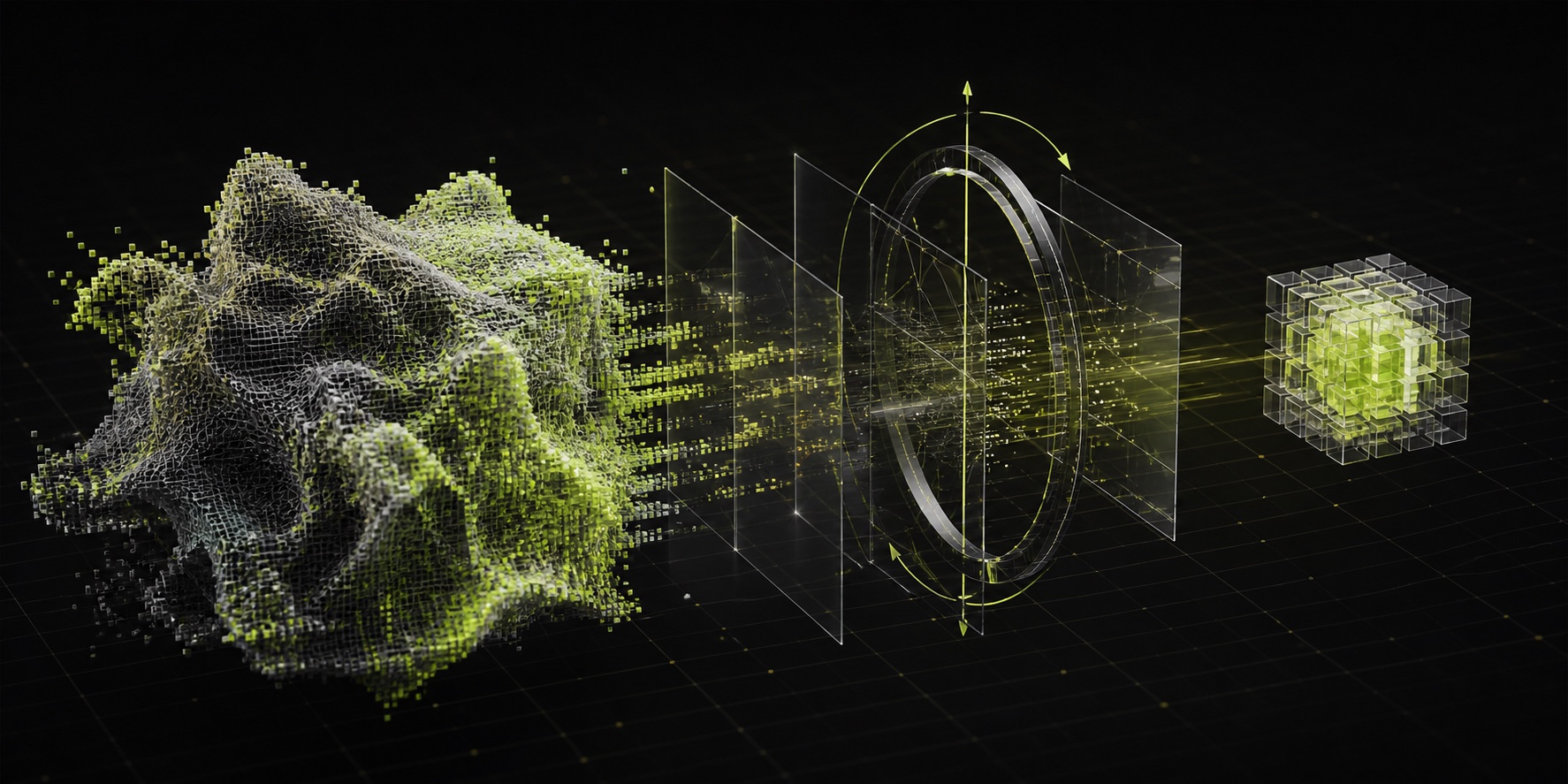
ConvRot applies a grouped, normalized Hadamard rotation before per-row INT8 weight quantization, then applies the matching rotation to activations at runtime. The purpose is to spread channel outliers so the INT8 grid is used more evenly. That explains the quality target; it does not prove that every layer, input, or backend is visually identical to BF16.
- The Comfy-Org artifact uses SafeTensors and ComfyUI quantization metadata, not GGUF packaging.
- A fused W8A8 path can improve speed, while an emulated or fallback path can erase that advantage.
- Keep a BF16 reference output for controlled geometry and material comparisons whenever hardware permits.
What the RX 7900 XTX benchmark actually shows
A community ROCm patch kit reports the measurements below on one RX 7900 XTX stack. They are useful evidence that the route can be fast on gfx1100; they are not a forecast for another AMD card, NVIDIA GPU, ComfyUI build, or complete workflow.
Community measurements: RX 7900 XTX, Python 3.12, PyTorch 2.14 ROCm 7.15, Triton 3.8. Lower is faster.
| Measured stage | GGUF Q4_K_M | INT8 ConvRot | Observed ratio |
|---|---|---|---|
| Cold structure flow | 4.927 s | 1.600 s | 3.08× |
| Cold shape flow | 5.802 s | 2.146 s | 2.70× |
| Warm structure flow | 0.341 s | 0.243 s | 1.40× |
| Warm shape flow | 0.791 s | 0.679 s | 1.16× |
| Complete 512 shape-only run | 131.67 s | 104.04 s | 1.27× |
Why 5.25 GB does not mean an 8 GB guarantee
The published number is the stored size of one diffusion checkpoint. Runtime weights, quantization scales, activations, attention workspaces, DINO conditioning, VAE decoding, sparse geometry, remeshing, UV rasterization, PBR textures, and framework allocations all contribute to the peak. CPU offload can move pressure into system RAM and paging rather than removing it.
- Report GPU model, operating system, driver, runtime, resolution, workflow, and input together.
- Measure the shape-only and textured routes separately; their peaks can occur in different stages.
- Treat out-of-memory, fallback, NaN, topology, and missing-material failures as separate outcomes.
Known trade-offs
- Comfy-Org hosting is a meaningful distribution signal, not proof that every TRELLIS.2 custom node already supports the file
- Near-BF16 quality is a design goal and community expectation; verify it with controlled outputs rather than repeating it as a universal result
- The 5.25 GB file size cannot be converted into a minimum-VRAM claim
- The public speed figures are from one RX 7900 XTX ROCm environment and include much smaller gains end to end than in selected cold flow stages
- Keep model provenance, licenses, wrapper commits, and hashes with any reproducible benchmark